
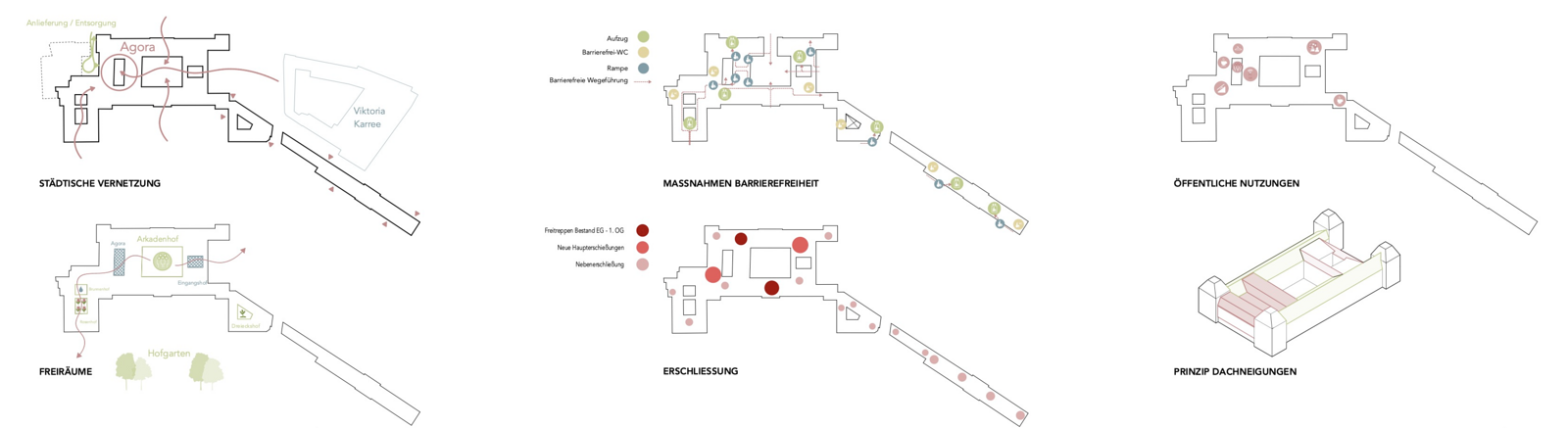
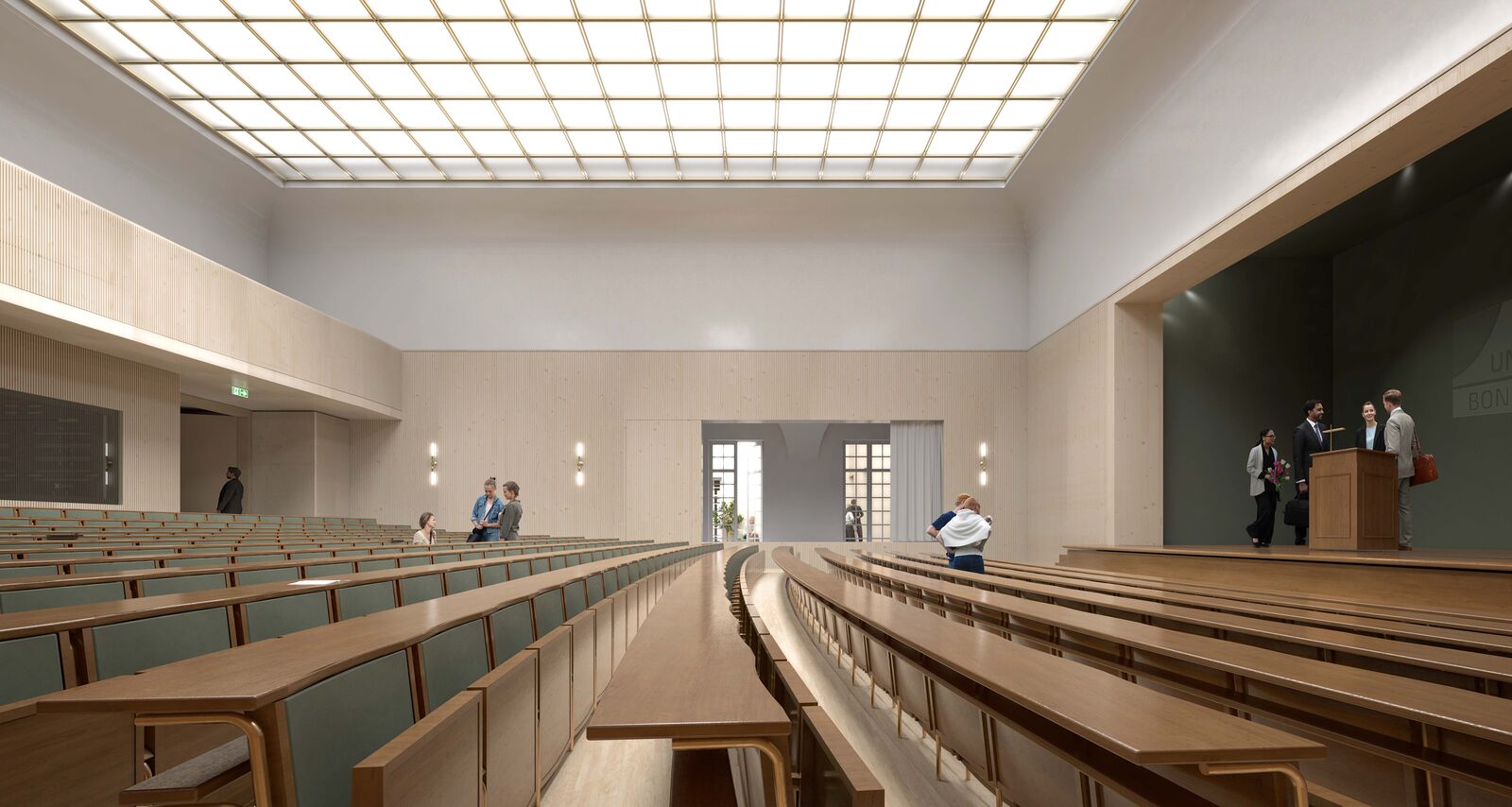
The castle complex’s many reshapes present both a challenge and an irresistible lure. The often cluttered spatial logic demands a fresh sense of order, but that clarity must not erase the historic narratives woven into the rooms. The design therefore introduces a clear, logic of urban and interior access through a handful of minimally invasive interventions, which read as a new temporal layer that never deviates from the baroque structure of the building.
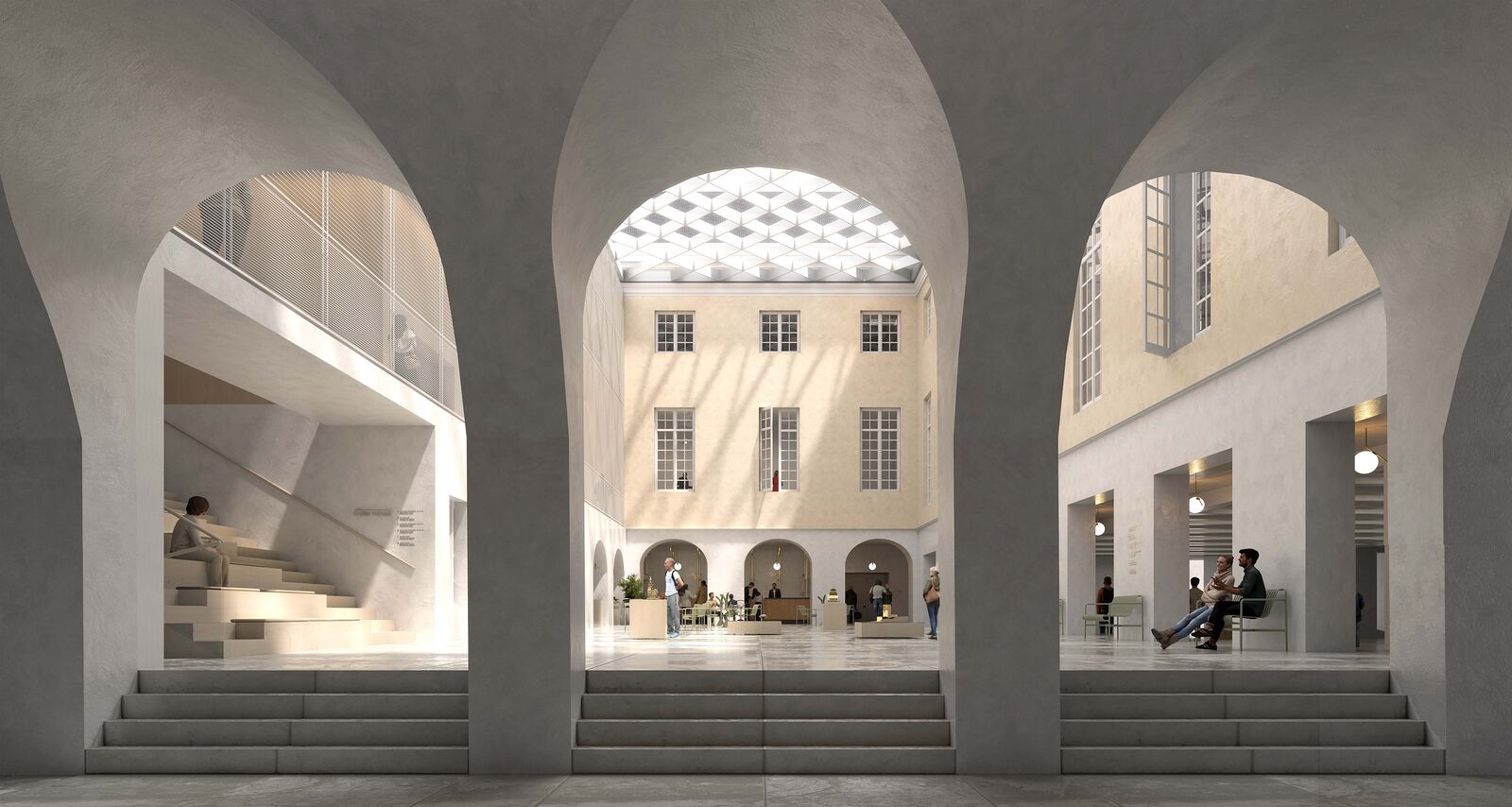
By relocating the skylight roof of the inner courtyard (Lichthof) to the roof ridge, the historic façades of the entrance courtyard (Eingangshof) regain visibility. The arcade courtyard (Arkadenhof) remains the civic nucleus of the ensemble, with the newly created, generous foyer feeding into it. The adjoining light courtyard is transformed into a covered agora—an open, publicly accessible heart of the university that hosts cafés, exhibitions, and event spaces.
The ground floor hosts all public focal points: the study centre in the Hofgarten wing, the student centre in the Kaiserplatz wing, the museum rooms, and the church. First‑floor is the teaching level, replete with large lecture halls, the auditorium (Aula), and all seminar rooms, making it the most heavily trafficked floor. The remaining upper levels are devoted to institutes, each housed on a single level. From this straightforward functional hierarchy, the clarity of future circulation is built.
Handling the Heritage
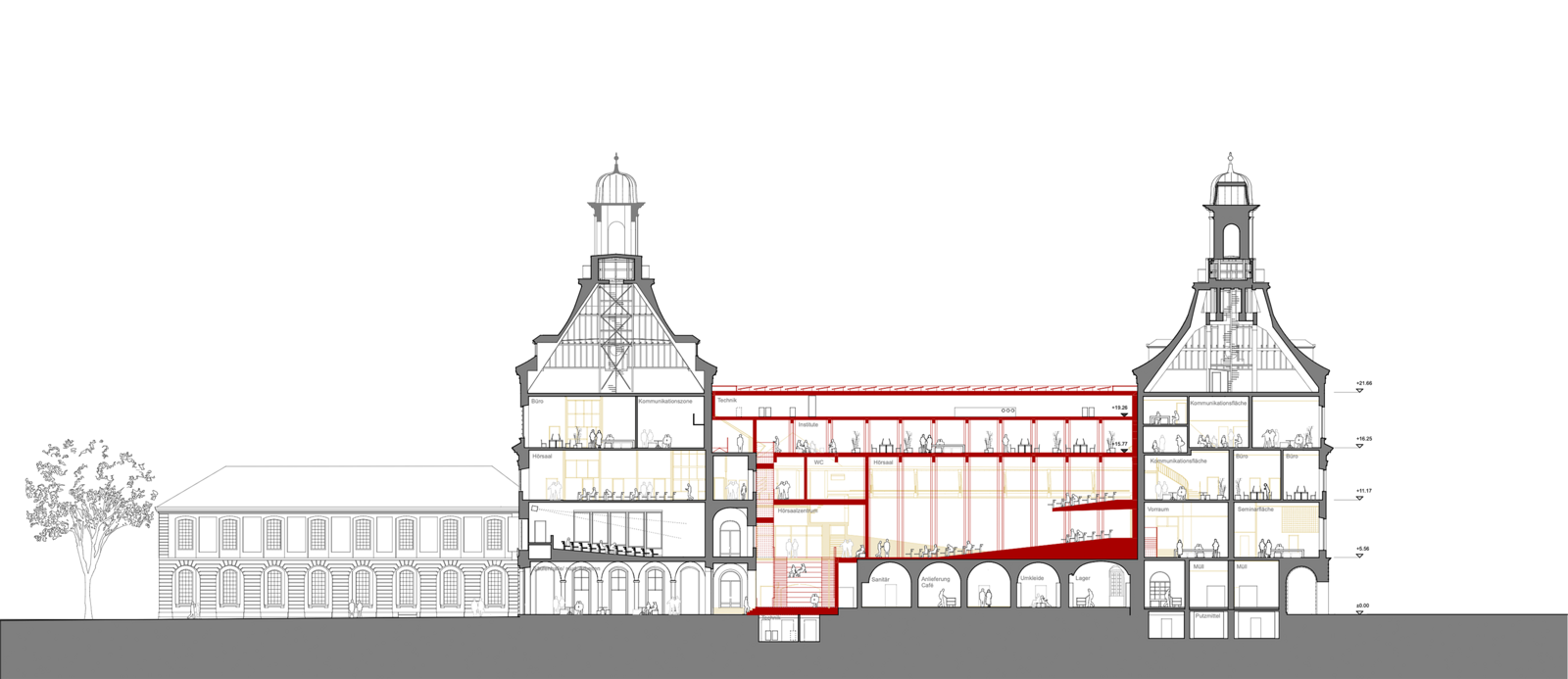
Two new access hubs—at the Agora and the entrance courtyard—serve as the central addresses on the ground floor. The two historic staircases that terminate at ground level remain vital routes to the auditorium, lecture halls, and seminar rooms. By confining major construction to the zone between the south and west towers—home to the new large lecture hall and the building‑services plant—and coupling this with a low‑tech mechanical concept, the design avoids large‑scale mechanical interventions and frees the roof spaces for generous open institute work areas.
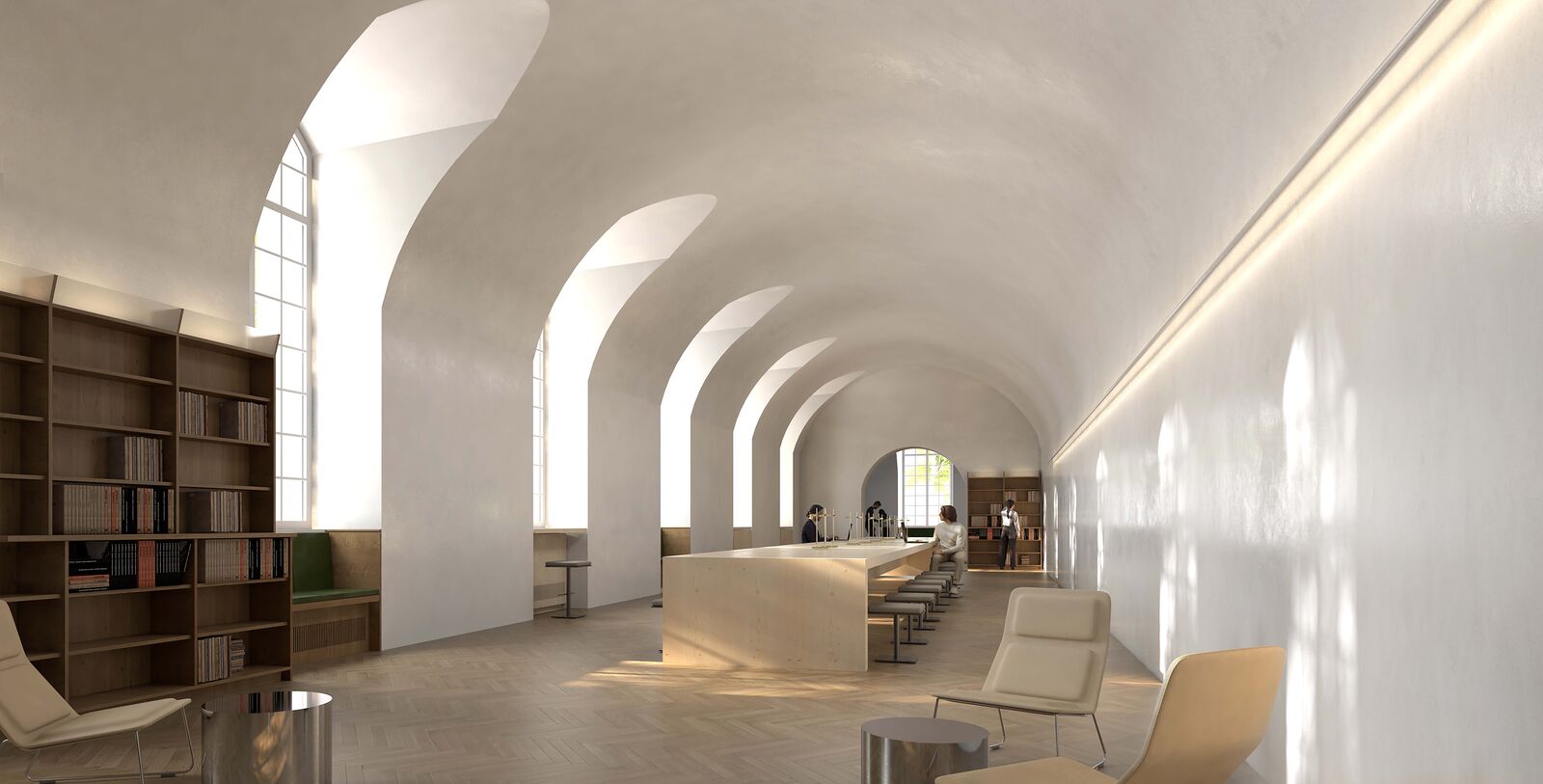
Lower levels see only the removal of non‑load‑bearing walls, the elimination of redundant auxiliary access routes, and the integration of new elevators, thereby securing full accessibility for the entire complex. Minimal interventions are limited to a few strategically critical points. Well‑preserved, historically significant fixtures—such as the pulpit in Lecture Hall 1, parts of the ground‑floor cloakrooms, and select shelving and seating in the student work areas—are slated for reuse to underscore the site’s layered history.
Beyond the two skylight roofs and the roof‑space expansion of the auditorium, the only major work involves demolishing the non‑listed Lecture Hall 10 and erecting a timber structure that accommodates a large lecture hall and an additional institute floor.
| Competition | 3rd Prize, 2025 |
| Client | Bau- und Liegenschaftsbetrieb NRW |
| User | Universität of Bonn |
Competition
Project Management:
Petra Wäldle, Bettina Schriewer
Team:
Andreas Mayr, Daniel Eichenberg, Marco Ullrich, Bastian Gerner, Jacob Steinfelder, Ruben Beilby, Mona Kraienhorst, Nina Lehrum-Stapenhorst, Janine Seiffert, Julius Dettmers, Karl Müller
Consulting Technical equipment, energy, building physics, fire protection : Arup Germany